
Private Tour: The Road to Tatev — From Ararat Through Wine and the Canyons of Syunik
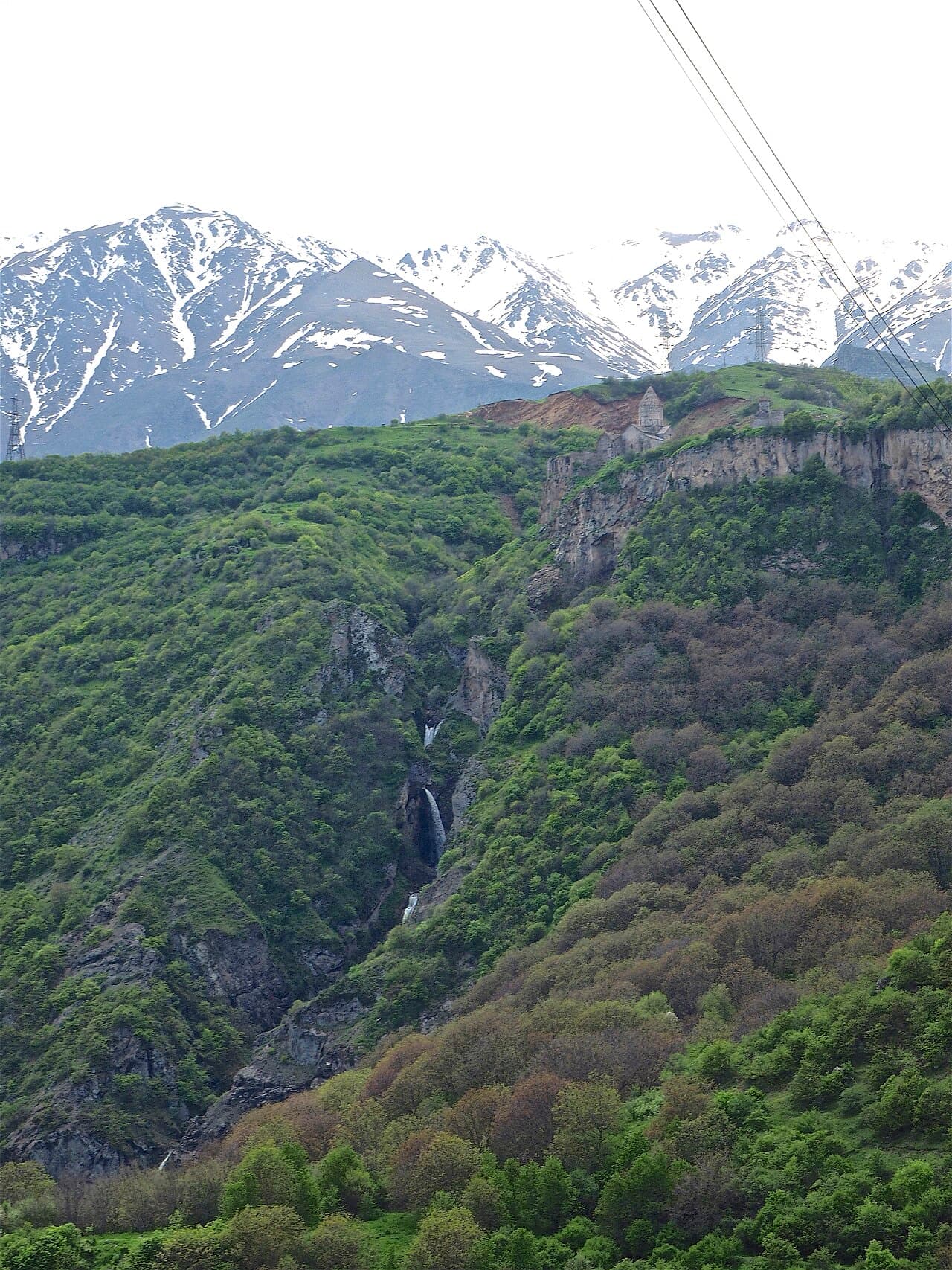
This is one of the most packed one-day routes in Armenia. In a single day we cross three completely different regions and watch the country change over hundreds of kilometers: in the morning, the Ararat valley and Khor Virap; then the vineyards of Vayots Dzor and the famous Areni wine; after that, the red cliffs and the medieval monastery of Noravank; further on, the road into Syunik, the Shaki waterfall and, finally, Tatev Monastery, standing above the vast Vorotan gorge. This is not just a sightseeing trip — it is a real journey through Armenia's history, nature and culture.
Early in the morning an Amaras Tour car arrives at the address you specify in Yerevan — your hotel, apartment or another pre-arranged place. An early departure is necessary because the route is long and packed, and in the private format we can pace the time calmly instead of turning the trip into a race. After pick-up we head south, toward the Ararat region.
The day's first stop is Khor Virap Monastery, one of the most famous and symbolic places in Armenia. The monastery stands almost right on the border with Turkey, and behind it, on a clear day, rises Mount Ararat — this is where one of the most famous views of the mountain opens up.
The history of this place is directly tied to Armenia's adoption of Christianity. The name "Khor Virap" translates as "deep dungeon": according to tradition, it was here that the Armenian king Trdat III had Gregory the Illuminator imprisoned for his Christian faith, and Gregory spent about 13 years in the underground dungeon.
Gregory the Illuminator became one of the central figures in the history of Armenian Christianity. According to church tradition, after long years of imprisonment he was freed, and it was his later activity that is linked to the conversion of the royal court and Armenia's adoption of Christianity as its state religion in the early 4th century — Armenia is traditionally considered the first country to officially adopt Christianity as a state religion.
The pit-dungeon connected with Gregory the Illuminator's imprisonment has survived on the monastery grounds. A narrow staircase leads down into it: the historical dungeon is about 6 meters deep, and for many guests this moment becomes one of the most powerful impressions of Khor Virap.
After exploring the monastery we always leave time for photographs. On a clear day this is where the classic panorama opens up: Khor Virap → the Ararat valley → Mount Ararat. Visibility is often better early in the morning, which is another reason an early start pays off on this route.
After Khor Virap we continue south. The Ararat valley gradually falls behind, the landscape becomes more mountainous, and we enter Vayots Dzor — one of Armenia's main wine-growing regions. The next stop is Areni.
The village of Areni is known throughout Armenia for its winemaking. It grows the local grape variety of the same name, Areni, well suited to the high-altitude climate, strong sun and stony soils of Vayots Dzor. It is used to produce red and rosé wines.
The winemaking history of this region is genuinely ancient. Not far from the village of Areni lies the Areni-1 cave, where archaeologists discovered a winemaking complex about 6,100 years old — considered one of the oldest known wineries in the world. Vessels for storing wine, containers for processing grapes, archaeological grape remains, seeds and other evidence of ancient winemaking were found in the cave, along with the famous ancient leather shoe.
In Areni we stop at one of the wineries. Guests learn about local winemaking traditions and can taste Armenian wines. Depending on the winery chosen, the program may include a story about the Areni grape variety, an introduction to the production process, a visit to the wine cellars, a tasting of several wines and the chance to buy any you liked. The tasting is paid separately if it is not included in the individual tour price.
The region lies high above sea level: there is plenty of sun during the day, while temperatures drop significantly at night. This difference between day and night temperatures helps the grapes retain their acidity and aroma, and the volcanic, stony soils play an additional role. That is why Vayots Dzor is considered today one of Armenia's most interesting wine regions.
After Areni we turn off the main highway. The road enters a narrow gorge, the cliffs grow higher, and their color gradually shifts from gray to red, orange and gold. At the end of the gorge, among these huge cliffs, Noravank Monastery appears.
The name "Noravank" translates as "New Monastery." The complex stands in one of the most beautiful canyons of Vayots Dzor; the main part of the monastic ensemble dates to the 13th–14th centuries, and Noravank was one of the important spiritual, cultural and educational centers of medieval Armenia.
Noravank's history is closely tied to the powerful princely house of Orbelian. It was with their support that the monastery flourished: new churches were built here, khachkars were carved, and masters and scholars worked at the site. Noravank became not only a monastery but also an important cultural center of Vayots Dzor.
One of the most famous figures associated with Noravank is the medieval architect, sculptor and miniaturist Momik, considered one of the greatest masters of the Armenian Middle Ages. His work combined architecture, sculpture and the finest stone carving.
One of Noravank's most recognizable structures is the two-story church of Surb Astvatsatsin, also known as Burtelashen, dating to the 14th century. The distinctive feature of the church is its unusual two-story composition: a narrow stone staircase set directly on the facade leads up to the upper level. This church has become one of the symbols of Noravank and of medieval Armenian architecture as a whole.
The facades of the complex display the finest ornaments and reliefs, with images of Christ, the Virgin and other religious scenes being especially notable. Traveling with a professional guide, you can explore the symbolism of each element in detail here.
Noravank cannot be imagined apart from the nature surrounding it. The monastery stands among tall reddish cliffs, and the color of the stone changes completely throughout the day: cooler in the morning, golden by midday, and taking on rich red tones toward evening. That is why Noravank is considered one of Armenia's most beautiful photo locations.
After Noravank we continue the long journey south. The road becomes increasingly mountainous as we pass through Vayots Dzor and gradually enter Syunik — one of Armenia's most mountainous regions, where deep gorges give way to high plateaus and the roads cross entirely different natural zones.
The next stop is the Shaki waterfall, located not far from Sisian. It is one of Armenia's most famous waterfalls: the water drops from a basalt ledge about 18 meters high.
The waterfall formed where the Shaki river crosses a mass of volcanic rock. Over thousands of years, the water gradually wore away the basalt layer, creating the tall rocky ledge the stream falls from today.
After several hours among historic sites, Shaki creates a completely different mood. Here you can take a walk, rest by the water and take beautiful photographs. Depending on the season, the strength of the flow can vary — the waterfall is usually at its fullest in spring and early summer.
After Shaki we continue toward one of Armenia's most famous monasteries. The road runs through Syunik, and the closer we get to Tatev, the deeper the gorges become and the more dramatic the mountain scenery. The vast Vorotan canyon opens up before us, and on the edge of the cliff stands Tatev.
Tatev is one of Armenia's major historical, spiritual and architectural monuments. The monastery stands high above the Vorotan gorge, and its setting is so striking that the place makes a powerful impression even before you learn its history. Tatev Monastery is one of the most visited historical sites in Syunik.
The site has early Christian roots, though the main monastic complex we see today took shape mostly in the 9th–10th centuries. The complex's main church is the Church of Saints Peter and Paul. Over time Tatev grew into one of the most important spiritual centers of medieval Armenia.
The monastery gained particular importance in the 14th–15th centuries, when the famous Tatev University operated here — one of the largest educational centers of medieval Armenia. Subjects taught there included philosophy, theology, grammar, mathematics, astronomy, geography, law, languages, music and the art of manuscript illumination. The outstanding Armenian thinkers Hovhan Vorotnetsi and Grigor Tatevatsi are both linked to Tatev University.
Grigor Tatevatsi was one of the greatest Armenian philosophers, theologians and teachers of the Middle Ages. He taught at Tatev and played a crucial role in developing the monastery school. His mausoleum stands on the complex grounds.
The monastery's main cathedral is Surb Poghos-Petros, the Church of Saints Peter and Paul, the architectural center of the whole complex. In the Middle Ages the church walls were decorated with frescoes, traces of which have survived to this day.
One of the complex's most unusual monuments is the Gavazan, a tall stone pillar erected in the year 906. Its construction allowed the pillar to sway slightly with movements of the earth, so it was regarded as a kind of medieval indicator of earthquakes and other tremors — one of the most unusual engineering objects of medieval Armenia.
The monastery was built on the edge of the deep Vorotan gorge. This location was both symbolic and practical: the high mountains provided a natural defense, while the monastery also controlled Syunik's important roads. Today this same location is why some of the most impressive views in Armenia open up from here.
If guests wish, the monastery visit can be combined with a ride on the "Wings of Tatev" cableway. It is about 5.7 kilometers long and is considered the world's longest reversible passenger cableway of its type. It connects the Halidzor area with Tatev, running high above the Vorotan gorge.
The cableway ride is an experience in its own right. The cabin travels over a huge gorge: below lie the road, the cliffs and the Vorotan river, while the monastery gradually appears ahead. Cableway tickets are paid separately, and its operation depends on the schedule and weather conditions.
We leave time to walk around the monastery and its viewpoints. This is a place that makes you want to stop and stay a while: ancient walls on one side, a huge gorge on the other, and on a clear day the mountains stretch away to the horizon.
After visiting Tatev we begin the drive back. It is a long journey, which is why the route is planned around an early start from the beginning. At the end of the trip the Amaras Tour car drops you off directly at the address you specified in Yerevan. The whole journey takes approximately 13–14 hours.
Useful information
Booking is required
You can only join the excursion with a booking made in advance. Please do not come to the meeting point without a confirmed reservation, as seats cannot be guaranteed on the day.
To book, contact Amaras Tour ahead of time with the tour you have chosen, your travel date and the number of people. Once we confirm availability we will send you everything you need to complete the booking.
- WhatsApp / Telegram: +374 99 250 525
After your booking is confirmed your seat in the group is held for you.
Meeting point and time
Meeting point: 51 Mesrop Mashtots Avenue, Yerevan, at the lower side of the Matenadaran, next to the Bus Voyage stop, where Koryun Street meets Mashtots Avenue.
Please arrive 10 to 15 minutes before departure so you have time to find the vehicle and take your seat. The excursion leaves on schedule.
Finding our vehicle
The Amaras Tour vehicle will be waiting at the meeting point. It carries an AMARAS TOUR sign in the windscreen, so it is easy to spot.
What the price includes
- Comfortable transport for the whole route
- A professional guide
- Commentary in Armenian, Russian or English
- Bottled water
- An Armenian treat from Amaras Tour
What the price does not include
- Entrance tickets
- Lunch and other meals
- Personal expenses
Entrance tickets
Entrance tickets are bought and paid for separately on site.
Meals
Lunch is not included in the price. Time is set aside for a meal during the tour, and your guide will suggest a suitable place to fit the programme and the timing.
You are welcome to bring a snack of your own.
Visiting churches and monasteries
The excursion visits working religious sites, so we ask you to dress respectfully and to follow the rules of conduct.
Clothing that covers the shoulders and knees is recommended. Please keep quiet inside the churches and bear in mind that services, weddings and other ceremonies may be taking place during your visit.
What to bring
We recommend bringing:
- comfortable shoes
- a hat in hot weather
- a light jumper or windbreaker in cooler months
- a snack if you would like one
Bottled water is provided by the company during the excursion.
Duration and programme
The approximate duration of the excursion is given in the tour description. The actual time of return may shift slightly depending on traffic, the weather and how long the group spends at each site.
The order in which the sights are visited may change for practical reasons, but the main points of the published route are always kept.
Route
- 1Khor Virap
- 2Areni
- 3Wine tour and tasting
- 4Noravank
- 5Shaki Waterfall
- 6Tatev Monastery