
From Ancient Gods to the Sanctuaries of Armenia
One day, several eras of Armenia. This route is ideal for a first introduction to the country. In a single day we see completely different chapters of its story: a panorama of Ararat, mountain landscapes, a 1st-century classical temple, extraordinary basalt cliffs and one of Armenia's most important medieval monasteries. The journey is designed so that history unfolds step by step — from Charents Arch and the nature of the Azat valley to pre-Christian Armenia, volcanic history and Christian Armenia. And all of it in a relaxed private format, with no large tour group and no rigid schedule.
At the agreed time, the Amaras Tour car arrives right at your address in Yerevan — your hotel, apartment or another place arranged in advance. There is no need to make your own way to a shared meeting point. The route is just for you and your party, so you can adjust how long each stop lasts, take extra photos and travel at a pace that suits you. The price is calculated individually and depends on the number of travellers, the car category you choose, the format of the trip — with a professional driver or with a separate professional tour guide — and any additional services. Standard, Comfort, Premium and Luxury cars are available, and professional drone filming can be added to your private trip on request.
The first stop is not far from Yerevan, on the road towards Garni. Here stands Charents Arch, one of the best-known viewpoints in this direction. The monument is dedicated to the great Armenian poet Yeghishe Charents, and the spot was not chosen by chance: Charents was especially fond of the image of Armenia and Ararat, which appears again and again in his work. The real attraction is not so much the arch itself as what lies beyond it. On a clear day Ararat is visible from here, with a wide panorama of Armenian mountains and valleys spread out before it. The arch becomes a natural frame for the view, which is why we make our first unhurried photo stop here. In the morning, when visibility is good, Ararat is at its most beautiful.
From Charents Arch we continue towards Azat Reservoir. This is a completely different Armenia: a wide expanse of water surrounded by dry volcanic mountains and strangely shaped terrain. Depending on the season, the water level and the sunlight, the landscape is always changing — the mountains turn green in spring, golden and brown tones appear in summer, and in autumn the surrounding relief becomes especially striking. On a private tour we stop at a suitable, safe viewpoint where you can take a leisurely walk, take photos and simply enjoy the scenery. It is also one of the most spectacular natural spots on the route for filming: weather permitting, and where flights are allowed, professional aerial drone footage can be shot here.
The whole next part of our journey is closely tied to the Azat River, which has shaped the surrounding landscape over thousands of years. The gorges, volcanic cliffs and basalt formations we will see further on make up one of the most unusual natural ensembles in central Armenia. Our next stop takes us into an entirely different historical era.
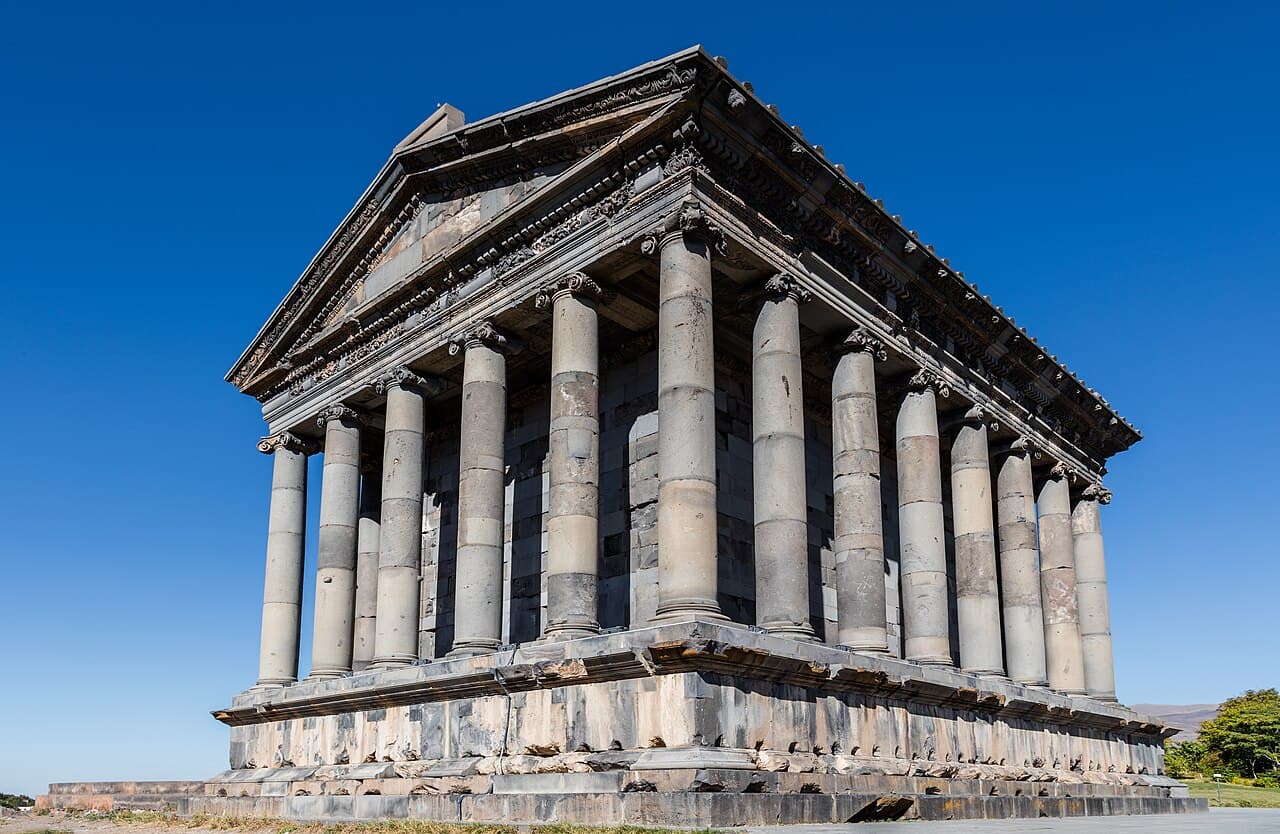
We arrive at the Garni archaeological complex, one of Armenia's most recognisable historic sites and a unique testament to its pre-Christian past. Its centrepiece is the famous temple of the 1st century AD, built in the time of the Armenian king Tiridates I — a Greek inscription found at Garni links the construction work to his reign. Garni reveals a very different page of Armenian history. Before adopting Christianity, Armenia had its own pagan religious traditions while also being strongly influenced by Hellenistic culture, and that blend is especially visible in Garni's architecture. The temple stands on a high stone podium surrounded by 24 Ionic columns. At first glance it recalls the classical temples of Greece and Rome, yet it is built of local basalt and belongs to the history of the ancient Kingdom of Armenia.
Garni was not only a religious site: it was also a mighty fortress and a royal residence. The location was chosen strategically. On several sides the plateau is protected by the deep gorge of the Azat River and almost sheer basalt walls, while the open side was guarded by a system of fortress walls and towers. Thanks to this, Garni long held great military and political importance. The remains of an ancient royal bathhouse survive within the complex, and its mosaic floor — with images drawn from classical mythology and the sea — is particularly interesting, further evidence of the close ties between ancient Armenian culture and the Hellenistic world. In the 17th century the temple was destroyed by a powerful earthquake, and for centuries its stone blocks lay scattered across the site. In the 20th century, after lengthy archaeological and architectural research, it was scientifically reconstructed using a large share of the original stones. Today Garni once again looks almost exactly as a classical temple should.
After Garni we descend into the gorge of the Azat River, home to one of Armenia's most unusual natural sites — the Symphony of Stones. It is also known as the Basalt Organ, and one look is enough to understand why. Thousands of long basalt columns rise above the gorge, most of them with regular polygonal shapes. They seem to hang from the cliffs like the pipes of a giant church organ — and, most remarkably, all of it was created by nature. These formations are volcanic in origin: as huge masses of lava slowly cooled and hardened, a network of cracks formed in the rock, producing regular basalt columns. Some are pentagonal or hexagonal, and it is this natural geometry that makes the cliffs look almost man-made. We leave time for a walk along the basalt walls, where the structure of the columns is especially fascinating up close. On one side flows the Azat River, on the other rise the enormous stone walls, and overhead the natural organ quite literally looms. After the walk we head on to the last, and one of the most powerful, historic sites of the day.
The road grows narrower, the mountains close in, and among the huge cliffs Geghard Monastery suddenly appears. It is one of the most outstanding monuments of medieval Armenian architecture, and together with the upper Azat valley it is a UNESCO World Heritage Site. The monastery's history reaches back to the early Christian era: according to tradition, it was founded in the early 4th century, after Armenia adopted Christianity. It was originally called Ayrivank, meaning the cave monastery, a name that perfectly describes its character. Geghard's defining feature is that some of its halls were not built in the usual way but carved directly into the rock. Rather than laying walls stone by stone, the masters worked their way into the solid cliff, gradually hollowing out the space of the future church. The result was churches, chapels, tombs and monks' quarters.
The main church of the complex, the Katoghike, was built in 1215. Much of the architectural ensemble we see today took shape in the 13th century, with the princely Proshyan family playing an especially important role in the monastery's development. Inside the rock-cut complex lies the famous Proshyan family tomb, where an unusual relief of animals survives on the wall — one of Geghard's most recognisable details. Travelling with a professional tour guide, this is a particularly rewarding place to explore the symbolism of medieval Armenian architecture. Some of Geghard's halls have remarkable acoustics: even a quiet voice sounds completely different inside the stone chambers, as the sound bounces off the walls and dome and creates a long, natural echo. A visit to the rock-cut halls is therefore an experience for the ears as well as the eyes. In one of the rock-hewn parts of the monastery there is a natural spring that was revered even before Christianity spread. Once the monastery was founded, the spring became part of the site's Christian tradition, and its water still flows today.
The monastery's present name comes from one of the most revered Christian relics. The word geghard means spear: according to Christian tradition, this is the spear that pierced Christ at the crucifixion. The relic was believed to have been brought to Armenia by the Apostle Thaddeus, and for several centuries it was kept right here — hence the name Geghardavank, the Monastery of the Spear. The relic was later moved to Etchmiadzin. Geghard is valued not only for its individual buildings: here nature and architecture are experienced as a single whole. Tall cliffs surround the monastery, some of its halls lie within those cliffs, and the monastic buildings seem to continue the mountain itself. It is this unique ensemble of Geghard and the upper Azat valley that UNESCO has recognised as a World Heritage Site.
After exploring Geghard we head back to Yerevan. At the end of the trip, the Amaras Tour car drops you off right at the address you give us — your hotel, apartment or another place arranged in advance. The private trip lasts about 7–8 hours in total. Amaras Tour — discover Armenia from classical antiquity to its medieval sanctuaries in one unforgettable day.
Useful information
Private tour with a professional driver
The private tour can be booked in two different formats.
- Private car of your chosen category
- Professional driver
- Pickup right at your address in Yerevan
- Transport throughout the route
- Charents Arch
- Azat Reservoir
- Garni Temple
- Symphony of Stones
- Geghard Monastery
- Panoramic and photo stops
- Drop-off right at the address you give us
- Bottled water
- Armenian treats from Amaras Tour
The professional driver provides transport along the route but does not replace a professional tour guide.
Private tour with a professional tour guide
- Private car of your chosen category
- Professional driver
- Separate professional tour guide
- Pickup right at your address
- Full guided accompaniment
- Historical and cultural commentary throughout the route
- Guided tour of Garni
- Guided visit to the Symphony of Stones
- Full guided tour of Geghard Monastery
- Charents Arch and Azat Reservoir
- Panoramic and photo stops
- Drop-off right at the address you give us
- Bottled water
- Armenian treats from Amaras Tour
The driver-only format and the format with a separate professional tour guide are priced separately.
Car categories
The following are available for private trips:
- Standard — a comfortable car for a private trip at the best value
- Comfort — a car with a higher level of comfort for a more relaxed journey
- Premium — high-end cars with extra space and comfort
- Luxury — executive-class cars for the most comfortable private journey
The specific car model is chosen based on the number of travellers, the selected category and vehicle availability on the date of the tour.
How the price is calculated
No fixed price is listed on this page. The price is calculated individually and depends on:
- The number of travellers
- The car category you choose
- The format — with a professional driver or with a separate professional tour guide
- Additional services
- Any changes or additions to the route
Once we have these details, Amaras Tour will calculate the exact price.
Entrance tickets
Entrance tickets are paid separately. The paid sites on the route are:
- Garni Temple
- Symphony of Stones
Charents Arch, the Azat Reservoir viewpoint and Geghard Monastery do not require a standard entrance ticket.
Meals
Meals are not included in the base price of the private tour.
If you wish, we can arrange a lunch stop during the trip — at an Armenian restaurant near Garni or another suitable place along the route. Since the tour is private, the time and length of lunch are agreed with you.
Armenian lavash masterclass
On request, a masterclass in making traditional Armenian lavash can be added to the programme. You will see how the dough is prepared and how the lavash is baked in a traditional tonir oven.
The masterclass is an optional extra and must be arranged in advance. Adding it may make the programme slightly longer.
Professional drone filming
Professional drone filming can be added to the private tour on request. Thanks to its variety of natural settings, this route is especially well suited to aerial footage.
Great shots can be captured:
- Around Charents Arch
- On the panoramic stretches of the Azat valley
- At Azat Reservoir
- In the open natural areas near Garni
- Among the mountain landscapes of Kotayk
Drone filming takes place only where it is permitted and depends on the weather, safety and current restrictions. At historical and cultural monuments, filming is done only where it is allowed.
What to bring
We recommend:
- Comfortable closed-toe shoes
- A hat in the warm season
- Sunglasses
- Sunscreen in summer
- A light sweater or windbreaker
- Personal medication if needed
Respectful clothing that covers the knees is recommended for visiting the monastery.
Can the route be changed?
Yes — this is one of the main advantages of a private trip. By prior arrangement you can:
- Change the departure time
- Spend more time at a place you like
- Add a lavash masterclass
- Arrange a lunch stop
- Add an extra natural or historical site along the way
- Add professional drone filming
If the mileage or duration increases significantly, the price is calculated separately.
Departure time
The car picks you up right at your address in Yerevan and, at the end of the trip, drops you off at the address you give us.
Since the tour is private, the pickup time can be changed by prior arrangement. For guests who want fewer tourists at the popular sites or are planning professional photo and video shoots, an earlier departure can be arranged.
- Meeting time: 08:45
- Departure: 09:00
Duration
About 7–8 hours. The duration may vary depending on:
- Your pace
- Time spent at the historical sites
- The length of the walk at the Symphony of Stones
- Lunch
- The lavash masterclass
- Extra stops
- Drone filming
- Traffic conditions
On a private tour, the point is not to rush through the programme but to see Armenia calmly, with interest and at your own rhythm.
Who this route is for
This private tour is one of the best options for a first introduction to Armenia. In one day you will see Ararat, Azat Reservoir, ancient Garni, the natural Symphony of Stones and medieval Geghard — a UNESCO World Heritage Site.
The route is ideal for:
- A first trip to Armenia
- Couples
- Families with children
- Friends and small groups
- Older travellers
- History and architecture lovers
- Anyone who wants beautiful photos and video footage
No special physical fitness is required.
Route
- 1Charents Arch
- 2Azat Reservoir
- 3Garni Temple
- 4Symphony of Stones
- 5Geghard Monastery