
Armenia's Grand Classic — From Ararat to Sevan
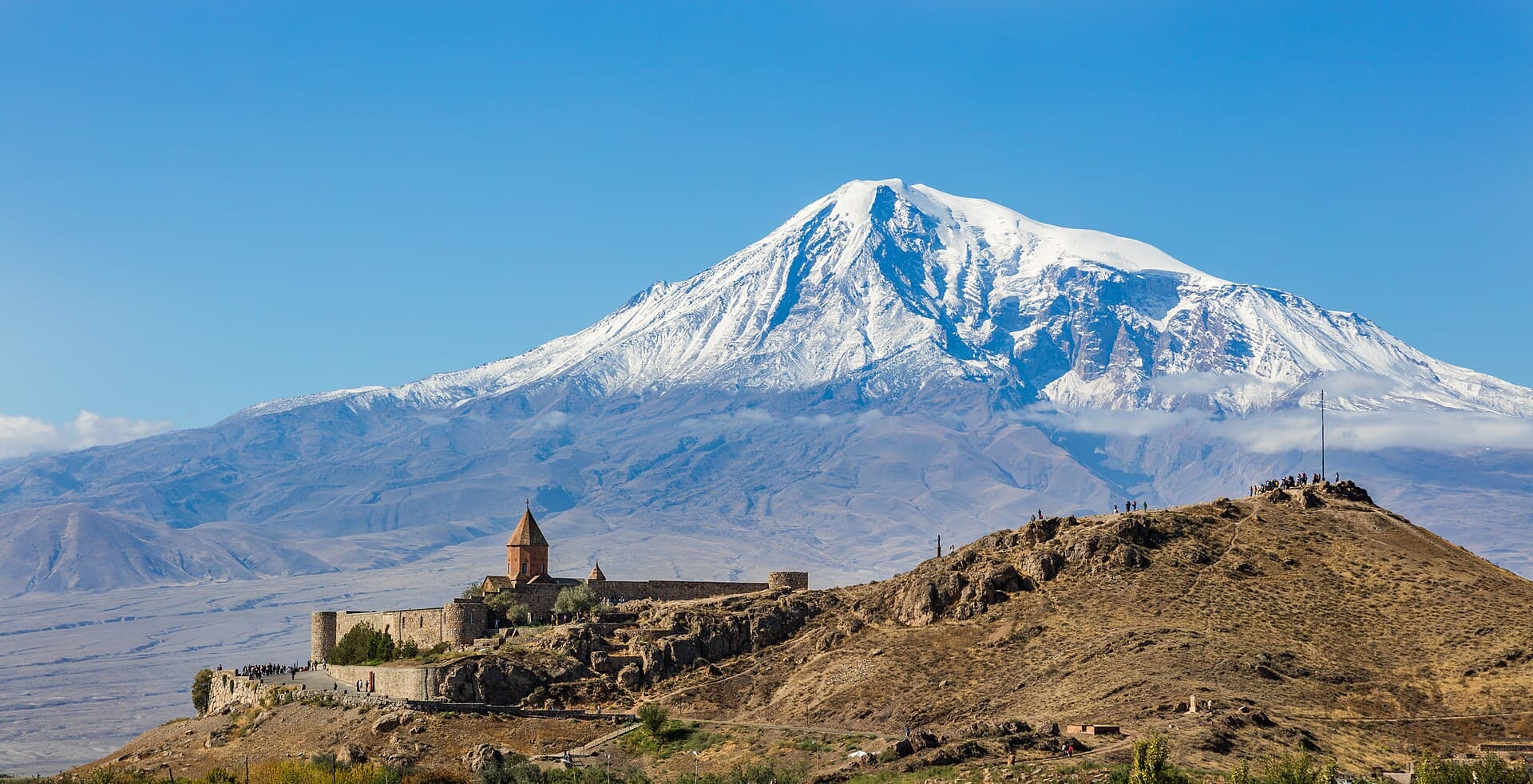
This route was created for those visiting Armenia for the first time and wanting to see several of its main symbols in a single day. In the morning we head to the foot of Ararat and discover the story of Khor Virap. Then we see the unusual Azat Reservoir. After that we travel back almost two thousand years to ancient Garni. We descend into the gorge to the famous Symphony of Stones. We see the monastery of Geghard, carved into the rock. And the journey ends at the vast highland Lake Sevan and the ancient Sevanavank. Ararat → antiquity → volcanic cliffs → a medieval monastery → highland Sevan. That is exactly why this route can rightly be called the Grand Classic of Armenia.
At 09:00 an Amaras Tour car arrives directly at the address you specify in Yerevan — your hotel, apartment or another pre-arranged place. You don't need to make your way to a common meeting point. There are no large tour groups and no waiting for other participants — this day belongs only to you and your company. We head south through the Ararat valley.
The first stop is Khor Virap Monastery, one of the most recognizable historical sites in Armenia. Behind the monastery, on a clear day, rises the majestic Mount Ararat — this is where one of the most famous views of the mountain opens up. But the significance of Khor Virap runs far deeper than a beautiful panorama: its history is directly linked to Armenia's adoption of Christianity.
The name "Khor Virap" translates as "deep dungeon". According to Armenian Christian tradition, a deep pit once stood here, into which King Trdat III ordered Gregory the Illuminator to be imprisoned for his Christian faith. Gregory spent around 13 years in captivity.
Gregory the Illuminator became one of the central figures in Armenian history. After many years of imprisonment he was freed: according to church tradition, Gregory healed King Trdat III, after which the king adopted Christianity. It is with these events that Armenia's adoption of Christianity as the state religion in the early 4th century is associated — the traditional date is the year 301.
On the monastery grounds there is an underground chamber which tradition links to Gregory the Illuminator's imprisonment. It is about 6 metres deep, and those who wish may climb down a narrow staircase. The descent is not obligatory — guests who find it uncomfortable can simply continue exploring the monastery.
The sanctity of this site goes back to the early Christian era. In the 7th century an early chapel was built here, and the present architectural ensemble took shape later, over different historical periods. Today Khor Virap remains one of the most important pilgrimage sites in Armenia.
A special place in this journey belongs to the panorama of Mount Ararat. Although the mountain now lies beyond Armenia's state border, for centuries Ararat has held a special place in Armenian history, culture, art and national identity. In good visibility you can see both Greater and Lesser Ararat from here — the mountain is especially beautiful in the morning. That is why we don't rush at the first stop and always leave time for photographs.
After Khor Virap, the direction of the trip changes: we head into the Kotayk region. As we drive, the landscape becomes increasingly volcanic, and unusual rocky mountains and valleys appear before us. The next stop is the Azat Reservoir.
The Azat Reservoir lies amid beautiful mountain terrain. The very combination of blue water, dry volcanic slopes and open space creates one of the most unusual landscapes of this direction. The colour of the water and the surrounding mountains changes considerably depending on the season and the light.
In spring the surrounding slopes turn green, in summer golden and brown tones prevail, in autumn the mountains take on warmer colours, and in winter the landscape becomes stark and minimalist. That is exactly why Azat looks different on almost every trip.
In the private format we make a stop at a suitable, safe viewpoint. Here you can take a walk, take photographs, shoot video, and enjoy nature without hurrying. This is one of the most interesting points on the route for professional aerial filming: in suitable weather, and where flights are permitted, drone footage can be added.
The next stop carries us from nature into ancient history. Before us is the archaeological complex of Garni. The main monument of the complex is the famous colonnaded temple of the 1st century AD, the only surviving Greco-Roman-style pagan temple in Armenia.
The temple's construction is associated with the Armenian king Trdat I. The temple dates to the 1st century AD, and there is a widespread theory that it was dedicated to the sun god Mihr. Garni, however, was not simply a temple — it was a large fortified royal complex.
Garni is especially important because it allows you to see Armenia before the adoption of Christianity. The complex's architecture shows the influence of the Hellenistic and Roman world: the temple stands on a high podium, surrounded by 24 Ionic columns, and the building's proportions, colonnade and decorative elements recall the ancient temples of the Mediterranean. At the same time, the building is built of local Armenian basalt.
Garni was a powerful fortress and royal residence. The complex's location itself was strategic: on several sides the plateau is bounded by a deep gorge and almost sheer cliffs, while on the open side the territory was protected by walls and towers. That is why, over the centuries, Garni held not only religious but also military significance.
The remains of an ancient bathhouse survive within the complex, and its mosaic floor is especially well known. The mosaic features images and scenes typical of ancient culture — one of the most fascinating elements of Garni, allowing you to picture the everyday life of the royal complex.
In the 17th century the temple of Garni was destroyed by a powerful earthquake, and for several centuries its stone blocks lay scattered around the original foundation. In the 20th century, following archaeological and architectural research, the temple was restored, and a significant part of the original stone elements was used in the reconstruction.
After visiting Garni we descend into the gorge of the Azat River. Here lies one of the region's main natural wonders — the Symphony of Stones, also known as the Basalt Organ. Before us stands an enormous wall of thousands of vertical stone columns.
The basalt columns have a remarkably regular geometric shape — many of them are pentagonal or hexagonal. They hang from the cliffs almost vertically and truly resemble the pipes of a giant musical organ. Hence the name: the Symphony of Stones.
The formation of the Symphony of Stones is linked to ancient volcanic activity. As hot lava gradually cooled and contracted, cracks appeared within the basalt mass, dividing the rock into regular polygonal columns. This process took place naturally over an enormous span of time.
We leave time for a walk along the basalt walls, where the true height of the columns is clearly visible. On one side runs the Azat River, on the other rise the basalt walls. It is a completely different atmosphere compared to the temple of Garni, even though the two sites are very close to each other.
After the Symphony of Stones we head further into the mountains. The road passes through a gorge, the cliffs grow ever higher, and among them appears the monastery of Geghard — one of the outstanding monuments of medieval Armenian architecture.
Geghard Monastery, together with the upper Azat River valley, is included on the UNESCO World Heritage list. The complex's main feature is the remarkable unity of architecture and surrounding nature: part of the monastery's chambers were built in the ordinary way, while part are literally carved inside the mountain rock.
The monastery's original name was Ayrivank, meaning "cave monastery". Tradition links its founding to Gregory the Illuminator and the early Christian era of the 4th century. The main architectural ensemble as it stands today took shape considerably later — mostly in the 13th century.
The monastery's central church, Katoghike, was built in 1215. Later a gavit, rock-cut churches, burial vaults and other chambers appeared around it.
The most striking part of Geghard lies inside the mountain. Medieval master builders did not lay walls from individual stones — they gradually carved the chambers directly out of the rock mass. This is how the rock-cut churches, burial vaults, chapels, monastic cells and khachkars came to be.
The monastery developed especially actively in the 13th century under the princely house of Proshyan. Much of the complex's rock-cut chambers are linked to them: inside is the famous burial vault of the Proshyan princes, its walls decorated with unusual medieval symbolism and stone reliefs.
Some of the chambers carved into the rock have unusual natural acoustics. Even a quiet sound here is reflected off the stone walls and amplified many times over — which is why sometimes a single voice is enough to fill the whole chamber with a lingering echo.
In one of the rock-cut sections of the monastery there is a natural spring, venerated since ancient times. Later the spring became part of the monastery's Christian tradition — the water still flows here today.
The word "Geghard" means "spear". The name is linked to a Christian relic — the spear which, according to tradition, was used at the Crucifixion of Christ. Armenian church tradition attributes the bringing of this relic to Armenia to the Apostle Thaddeus. For a certain period the spear was kept in the monastery, which is why Ayrivank gradually became known as Geghardavank — the Monastery of the Spear. Later the relic was moved to Etchmiadzin.
After Geghard, the next part of the great journey begins. We leave the rocky gorges of Kotayk behind and head toward the Gegharkunik region. After a while an enormous blue expanse opens up before us — this is Lake Sevan.
Sevan is the largest lake in Armenia and one of the country's main natural symbols. It lies at an altitude of roughly 1,900 metres above sea level, which makes Sevan one of the largest highland freshwater lakes in the region.
Armenians often call Sevan the "Armenian sea" — looking out over the vast surface of the water, the name makes perfect sense: from certain points, the opposite shore all but disappears into the haze. The colour of the water is constantly changing: in sunny weather the lake can be bright blue or turquoise, in cloudy weather deep blue or grey.
Sevan is surrounded by mountain ranges, and it is precisely the combination of water and mountains that creates its distinctive landscape. Even in summer it is often cooler and windier here than in Yerevan, so a light jumper or windbreaker is almost always useful.
On a peninsula above Sevan stands the famous Sevanavank Monastery. We climb up to it by a staircase, and with every step the panorama grows wider. At the top opens one of the most recognizable views in Armenia: ancient stone churches, an immense lake, and mountains.
The complex's main surviving churches date to the 9th century. In the year 874 the churches of Surb Arakelots — the Holy Apostles — and Surb Astvatsatsin — the Holy Mother of God — were built here. Their construction is linked to Princess Mariam, daughter of Ashot Bagratuni, the future King Ashot I.
Today the monastery stands on a peninsula, but historically it was a true island: Sevanavank was surrounded by water on every side. In the 20th century the level of Lake Sevan dropped considerably, and as a result the former island became joined to the shore and turned into a peninsula.
Sevanavank was an important spiritual centre — the island's remoteness made it especially well suited to monastic life. Today the main value of this point for a traveller is the union of history with a truly grand natural landscape.
Since Sevan becomes the last major point on the route, given a suitable season and schedule, beautiful evening light can often be caught here. The lake feels especially atmospheric closer to sunset, when the sun sinks lower and the colour of the water gradually changes. In the private format, the length of the earlier stops can be adjusted if guests want to spend more time at Sevan.
Meals are not included in the base cost of the tour. On request, a lunch stop can be arranged — in Garni, along the way between locations, or on the shore of Sevan. If guests would like to try Sevan's fish, a restaurant by the lake can make a beautiful close to the journey. The place and length of lunch are agreed individually.
On request, a masterclass in making traditional Armenian lavash can be added to the programme in the Garni area. Guests will see how the dough is prepared and how the lavash is baked in a traditional tonir. The masterclass is an additional service, and adding it may extend the overall length of the trip.
After Sevanavank we begin the journey back. At the end of the trip, the Amaras Tour car takes you directly to the address you specify in Yerevan. The tour's approximate duration is 10–11 hours, and with a longer lunch, a masterclass, extra stops or professional filming, the programme may take longer.
Useful information
Booking is required
You can only join the excursion with a booking made in advance. Please do not come to the meeting point without a confirmed reservation, as seats cannot be guaranteed on the day.
To book, contact Amaras Tour ahead of time with the tour you have chosen, your travel date and the number of people. Once we confirm availability we will send you everything you need to complete the booking.
- WhatsApp / Telegram: +374 99 250 525
After your booking is confirmed your seat in the group is held for you.
Meeting point and time
Meeting point: 51 Mesrop Mashtots Avenue, Yerevan, at the lower side of the Matenadaran, next to the Bus Voyage stop, where Koryun Street meets Mashtots Avenue.
Please arrive 10 to 15 minutes before departure so you have time to find the vehicle and take your seat. The excursion leaves on schedule.
Finding our vehicle
The Amaras Tour vehicle will be waiting at the meeting point. It carries an AMARAS TOUR sign in the windscreen, so it is easy to spot.
What the price includes
- Comfortable transport for the whole route
- A professional guide
- Commentary in Armenian, Russian or English
- Bottled water
- An Armenian treat from Amaras Tour
What the price does not include
- Entrance tickets
- Lunch and other meals
- Personal expenses
Entrance tickets
Entrance tickets are bought and paid for separately on site.
Meals
Lunch is not included in the price. Time is set aside for a meal during the tour, and your guide will suggest a suitable place to fit the programme and the timing.
You are welcome to bring a snack of your own.
Visiting churches and monasteries
The excursion visits working religious sites, so we ask you to dress respectfully and to follow the rules of conduct.
Clothing that covers the shoulders and knees is recommended. Please keep quiet inside the churches and bear in mind that services, weddings and other ceremonies may be taking place during your visit.
What to bring
We recommend bringing:
- comfortable shoes
- a hat in hot weather
- a light jumper or windbreaker in cooler months
- a snack if you would like one
Bottled water is provided by the company during the excursion.
Duration and programme
The approximate duration of the excursion is given in the tour description. The actual time of return may shift slightly depending on traffic, the weather and how long the group spends at each site.
The order in which the sights are visited may change for practical reasons, but the main points of the published route are always kept.
Route
- 1Khor Virap
- 2Azat Reservoir
- 3Garni Temple
- 4Symphony of Stones
- 5Geghard Monastery
- 6Lake Sevan
- 7Sevanavank Monastery