
Private Tour: From Ararat to Ancient Geghard
The main advantage of a private trip is the absence of a large group and a rigid group schedule. At the agreed time, the car arrives at the address you specify in Yerevan — a hotel, an apartment, or another agreed meeting point. You don't need to make your own way to a common gathering point. The route runs only for you and your company. This means you can distribute your time between the sights more flexibly, make extra photo stops, and spend more time at the places you like.
At the agreed time, the car picks you up directly from your specified address. The first direction of our journey is the Ararat Valley. As we move away from Yerevan, one of Armenia's most recognizable landscapes opens up before us — Mount Ararat. Our first stop is almost right at the border — the ancient monastery of Khor Virap.
Khor Virap is one of the most symbolic places in Armenia. Its name translates as "deep dungeon". It was here, according to Armenian Christian tradition, that King Trdat III imprisoned Gregory the Illuminator in a deep pit, where he spent about 13 years. Gregory was later freed and played a key role in Armenia's adoption of Christianity at the beginning of the 4th century. Today visitors can descend into the dungeon connected with this story. But Khor Virap is known not only for its spiritual history. It is from here that one of the most famous views of Greater and Lesser Ararat opens up. On a clear day the mountain seems very close. In the private format there is no need to rush here: we leave enough time to explore the monastery, walk around, and take photos. If you choose a professional guide, you will also get a detailed account of the monastery's history, Gregory the Illuminator, and Armenia's adoption of Christianity.
After Khor Virap we change direction and head to the Azat Reservoir. This is already a completely different landscape. The water here is surrounded by dry volcanic mountains and rocky slopes. Depending on the season and the light, the color of the reservoir keeps changing. It's one of the most beautiful natural photo spots on the route. On the private tour there is a stop at a safe panoramic viewpoint. If weather and flight regulations allow, this is exactly where an impressive drone video can be arranged.
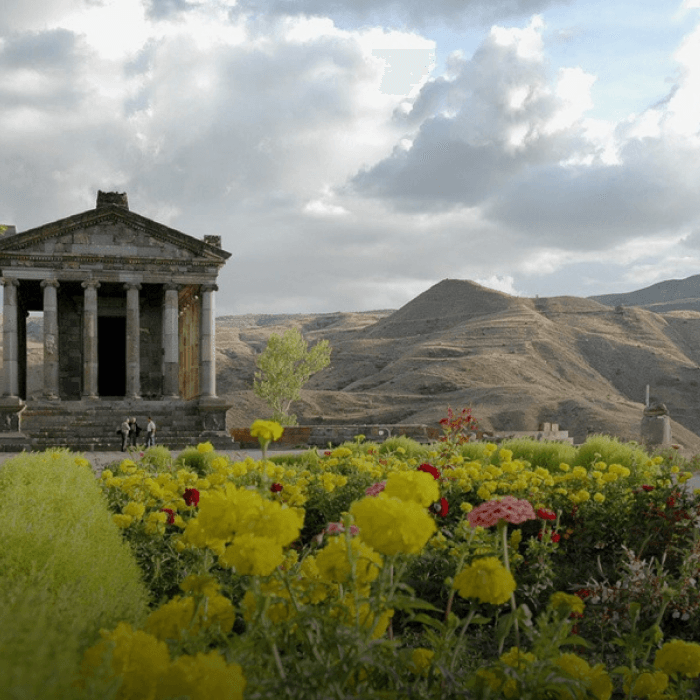
The next major stop is the archaeological complex of Garni. The history of this area is much older than its famous temple: archaeological finds show that people were present here as far back as prehistoric times. The main landmark of the complex is a 1st-century AD temple. It represents a completely different page of Armenian history — the pre-Christian era. The temple stands on a high plateau above the gorge of the Azat river and is surrounded by basalt cliffs. The site also preserves the remains of an ancient fortress, royal buildings, and a bathhouse with a mosaic floor. This place lets you move, quite literally, from ancient pre-Christian Armenia to the next part of the route — Christian Geghard.
From Garni we descend into the gorge of the Azat river. Here is one of the most unusual natural monuments in Armenia — the Symphony of Stones, also known as the Basalt Organ. Enormous natural basalt columns rise above the gorge. Many of them are five- or six-sided and really do resemble the pipes of a giant organ. Despite their almost perfect geometry, this is not the work of human hands. Such structures were formed by natural geological processes in volcanic rock. There is time here for a walk through the gorge and for photos.
The final historical point of the journey is Geghard Monastery. It is one of the outstanding works of medieval Armenian architecture. The monastery's history begins in the early Christian era. It was originally called Ayrivank — the "Cave Monastery". The present architectural ensemble largely took shape in the 13th century. The main church was built in 1215. But Geghard's most unusual feature is inside. Some of its churches, chapels and burial vaults are not built from separate stones — the chambers are literally carved directly into the rock. Here the union of architecture and surrounding nature is especially palpable. High cliffs almost enclose the monastery. Geghard, together with the upper Azat river valley, is included in the UNESCO World Heritage list.
In one of the rock-hewn parts of the complex there is a natural spring. It was venerated even before the spread of Christianity, and later became part of the monastic tradition. It was right next to this spring that the early monastic community arose.
The word "geghard" means "spear" in Armenian. The name is connected with the Christian legend of the Spear that pierced Christ. The relic was kept at the monastery for a long time, which is why the monastery received its present name — Geghardavank, the "Monastery of the Spear".
After visiting Geghard we head back to Yerevan. At the end of the journey the car drops you off at the address you specified — a hotel, an apartment, or another pre-arranged place. The estimated total duration of the trip is 8–9 hours.
Useful information
Booking is required
You can only join the excursion with a booking made in advance. Please do not come to the meeting point without a confirmed reservation, as seats cannot be guaranteed on the day.
To book, contact Amaras Tour ahead of time with the tour you have chosen, your travel date and the number of people. Once we confirm availability we will send you everything you need to complete the booking.
- WhatsApp / Telegram: +374 99 250 525
After your booking is confirmed your seat in the group is held for you.
Meeting point and time
Meeting point: 51 Mesrop Mashtots Avenue, Yerevan, at the lower side of the Matenadaran, next to the Bus Voyage stop, where Koryun Street meets Mashtots Avenue.
Please arrive 10 to 15 minutes before departure so you have time to find the vehicle and take your seat. The excursion leaves on schedule.
- Departure: рекомендуем 09:00
Finding our vehicle
The Amaras Tour vehicle will be waiting at the meeting point. It carries an AMARAS TOUR sign in the windscreen, so it is easy to spot.
What the price includes
- Comfortable transport for the whole route
- A professional guide
- Commentary in Armenian, Russian or English
- Bottled water
- An Armenian treat from Amaras Tour
What the price does not include
- Entrance tickets
- Lunch and other meals
- Personal expenses
Entrance tickets
- Garni Temple
- Symphony of Stones
Entrance tickets are bought and paid for separately on site.
Meals
Lunch is not included in the price. Time is set aside for a meal during the tour, and your guide will suggest a suitable place to fit the programme and the timing.
You are welcome to bring a snack of your own.
Visiting churches and monasteries
The excursion visits working religious sites, so we ask you to dress respectfully and to follow the rules of conduct.
Clothing that covers the shoulders and knees is recommended. Please keep quiet inside the churches and bear in mind that services, weddings and other ceremonies may be taking place during your visit.
What to bring
We recommend bringing:
- comfortable shoes
- a hat in hot weather
- a light jumper or windbreaker in cooler months
- a snack if you would like one
Bottled water is provided by the company during the excursion.
Duration and programme
The approximate duration of the excursion is given in the tour description. The actual time of return may shift slightly depending on traffic, the weather and how long the group spends at each site.
The order in which the sights are visited may change for practical reasons, but the main points of the published route are always kept.
Route
- 1Khor Virap
- 2Azat Reservoir
- 3Garni Temple
- 4Symphony of Stones
- 5Geghard Monastery