
Private Tour: From Ancient Gods to the Sacred Sites of Armenia
One Day — Several Epochs of Armenia
This route is perfect for a first acquaintance with Armenia.
In a single day we see completely different pages of the country's history: a panorama of Ararat, mountain landscapes, a 1st-century antique temple, extraordinary basalt cliffs and one of Armenia's most important medieval monasteries.
The journey is built so that history unfolds gradually:
Charents Arch → the nature of the Azat valley → pre-Christian Armenia → volcanic history → Christian Armenia.
And all of this in a calm, private format, without a large tour group or a rigid schedule.
09:00 — Departure from Yerevan
At the agreed time, an Amaras Tour car arrives directly at the address you specify in Yerevan — your hotel, apartment or any other pre-arranged place.
You don't need to make your own way to a common meeting point.
The route is run just for you and your company.
You can adjust how long you spend at each stop, take extra photos and travel at whatever pace suits you.
Charents Arch
The first stop is not far from Yerevan, on the road toward Garni.
Before us is Charents Arch, one of the best-known panoramic viewpoints in this direction.
The monument is dedicated to the great Armenian poet Yeghishe Charents.
The site was not chosen by chance.
Charents was especially fond of the image of Armenia and Ararat, which appears repeatedly in his poetry.
The View of Ararat
What matters here is not really the architecture of the arch itself.
What matters is what opens up beyond it.
On a clear day, Ararat is visible from here, with a wide panorama of Armenian mountains and valleys unfolding before it.
The arch quite literally becomes a natural frame for this landscape.
That is why this is where we make our first relaxed stop for photos.
In the morning, with good visibility, Ararat is especially beautiful.
Azat Reservoir
After Charents Arch we continue toward the Azat Reservoir.
This is already a completely different Armenia.
Before us opens a vast expanse of water, surrounded by dry volcanic mountains and a striking relief.
Depending on the season, the water level and the sunlight, the landscape here is constantly changing.
In spring the mountains turn green.
In summer golden and brown tones appear.
In autumn the surrounding terrain becomes especially contrasted.
View of the Azat Reservoir
On the private tour we stop at a suitable, safe viewpoint.
Here you can take a quiet walk, take photos and simply enjoy the scenery.
This is also one of the most striking natural locations on the route for filming.
In suitable weather, and wherever flights are permitted, professional drone footage can be captured here.
The Azat River Valley
The whole next part of our journey is closely tied to the Azat River.
It is this river that has shaped the surrounding landscape over thousands of years.
The gorges, volcanic cliffs and basalt formations we will see next form one of the most unusual natural ensembles in central Armenia.
The next stop takes us into an entirely different historical era.
Garni Temple
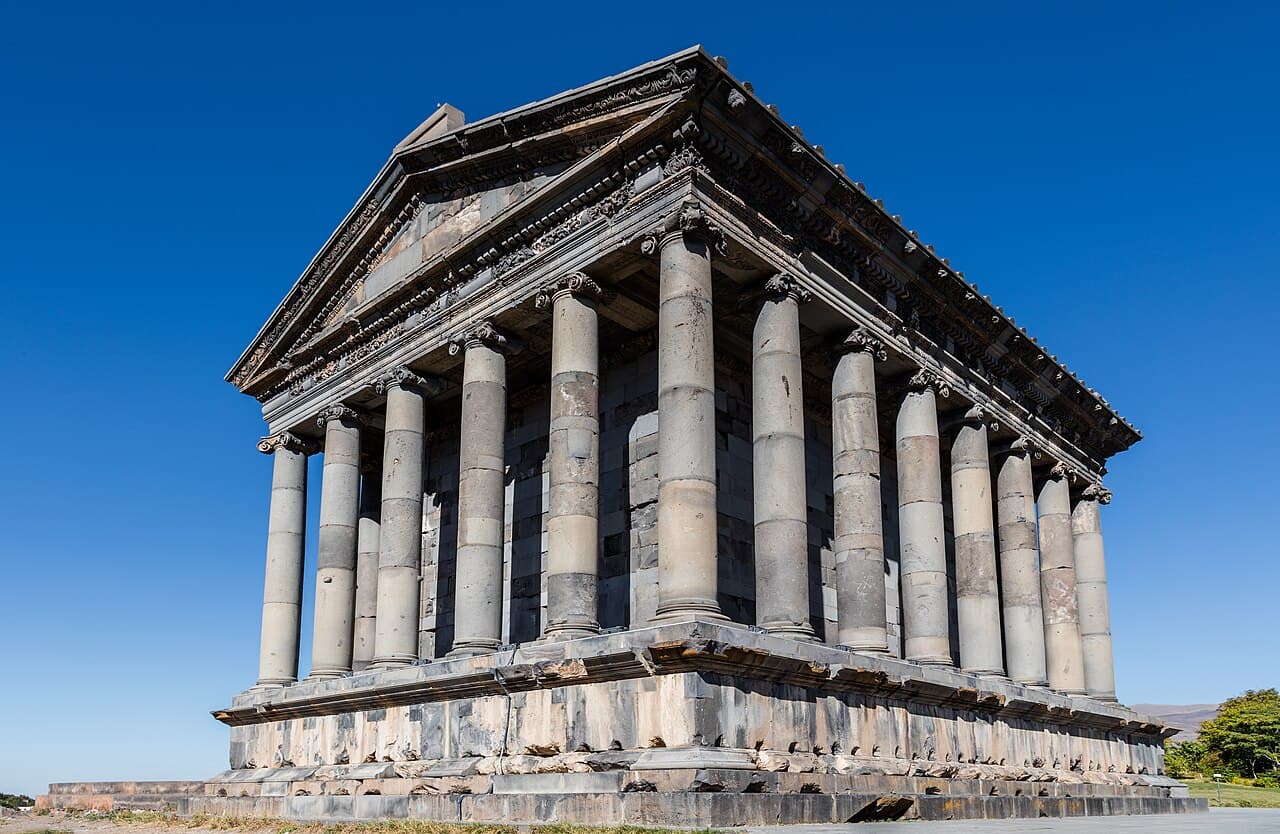
Before us is the archaeological complex of Garni.
It is one of the most recognizable historic sites in Armenia and a unique testament to its pre-Christian past.
The complex's main monument is the famous 1st-century temple.
It was built during the reign of the Armenian king Trdat I.
A Greek inscription found on the grounds of Garni links the construction work to his reign.
Armenia Before Christianity
Garni lets us see a completely different page of Armenian history.
Before adopting Christianity, Armenia had its own pagan religious traditions, while at the same time experiencing strong Hellenistic influence.
This fusion is especially visible in Garni's architecture.
The temple stands on a tall stone podium and is surrounded by 24 Ionic columns.
At first glance it recalls the ancient temples of Greece and Rome.
But it is built of local basalt and is part of the history of the ancient Armenian kingdom.
Garni Fortress
Garni was not only a religious site.
A powerful fortress and royal residence once stood here.
The location was chosen strategically.
On several sides the plateau is protected by the deep gorge of the Azat River and by nearly sheer basalt walls.
On the open side there was once a system of fortress walls and towers.
Thanks to this, Garni held major military and political importance for a long time.
The Royal Bathhouse and Ancient Mosaic
The remains of an ancient royal bathhouse have survived on the grounds of the archaeological complex.
Especially interesting is a mosaic floor depicting scenes tied to ancient mythology and the sea.
This is yet another testament to the close connection between ancient Armenian culture and the Hellenistic world.
Earthquake and the Temple's Restoration
In the 17th century the temple was destroyed by a powerful earthquake.
For centuries its stone blocks remained scattered across the site.
In the 20th century, after lengthy archaeological and architectural research, the temple was scientifically reconstructed.
The work was carried out using a significant portion of the original stones.
Today Garni once again looks much as the ancient temple would have looked.
Symphony of Stones
After Garni we descend into the gorge of the Azat River.
Here lies one of the most unusual natural sites in Armenia — the Symphony of Stones.
It is also called the Basalt Organ.
One glance is enough to understand where the name comes from.
A Stone Organ Made by Nature
Thousands of long basalt columns rise above the gorge.
Most of them have a regular polygonal shape.
They seem to hang from the cliffs, resembling the pipes of an enormous church organ.
The most astonishing thing is that all of this was created by nature.
How the Symphony of Stones Was Formed
These formations are of volcanic origin.
As huge masses of lava gradually cooled and hardened, a network of cracks formed within the rock.
As a result, regular basalt columns took shape.
Some are pentagonal, others hexagonal.
It is precisely this natural geometry that makes the cliffs look almost man-made.
A Walk Through the Gorge
We set aside time for a walk along the basalt walls.
Here it's especially interesting to see the structure of the columns up close.
On one side is the Azat River.
On the other, enormous stone walls.
And overhead, the natural "organ" quite literally looms above you.
After the walk we continue on to the last, and one of the most powerful, historical points of the day.
Geghard Monastery
The road grows narrower.
The mountains draw closer.
And among huge cliffs, Geghard Monastery suddenly appears.
It is one of the most outstanding monuments of medieval Armenian architecture.
The monastery and the upper Azat valley are inscribed on the UNESCO World Heritage list.
From Ayrivank to Geghard
The monastery's history begins back in the early Christian era.
According to tradition, it was founded in the early 4th century, after Armenia adopted Christianity.
It was originally called Ayrivank.
The name translates as "cave monastery."
And that name describes its character perfectly.
Chambers Carved Into the Rock
Geghard's main feature is that part of its chambers were not built in the usual way.
They are carved directly into the rock.
The builders did not lay stone upon stone.
Instead they cut into the massive cliff and gradually carved out the space of the future temple.
This produced churches, chapels, burial vaults and monastic chambers.
The Main Church
The complex's main church, the Katoghike, was built in 1215.
Much of the architectural ensemble we see today took shape in the 13th century.
The princely house of Proshyan played an especially important role in the monastery's development.
The Proshyan Family Burial Vault
Inside the rock-hewn complex lies the famous Proshyan family burial vault.
An unusual relief depicting animals has survived on its wall.
It is one of the most recognizable elements of Geghard.
When traveling with a professional guide, it's especially interesting to unpack the symbolism of medieval Armenian architecture here.
Astonishing Acoustics
Some of Geghard's chambers have extraordinary acoustics.
Even a quiet voice sounds completely different inside the stone space.
Sound reflects off the walls and dome, producing a long, natural echo.
That is why visiting the rock-cut halls becomes not just a visual experience, but a sonic one too.
The Sacred Spring
In one of the rock-cut sections of the monastery there is a natural spring.
It was revered even before the spread of Christianity.
After the monastery was founded, the spring became part of the site's Christian tradition.
The water still flows here today.
Why the Monastery Is Called Geghard
The modern name is tied to one of the most venerated Christian relics.
The word "geghard" means "spear."
According to Christian tradition, it refers to the spear that pierced Christ during the crucifixion.
The relic was believed to have been brought to Armenia by the Apostle Thaddeus.
For several centuries it was kept right here.
Hence the name:
Geghardavank — the Monastery of the Spear.
The relic was later transferred to Etchmiadzin.
Geghard and UNESCO
Geghard's value lies in more than its individual buildings.
Here nature and architecture are perceived as a single whole.
Tall cliffs surround the monastery.
Part of its chambers lie within those cliffs.
The monastery's structures seem to be a continuation of the mountain itself.
It is precisely this unique ensemble of Geghard and the upper Azat valley that has been recognized as a UNESCO World Heritage site.
Return to Yerevan
After visiting Geghard, we head back to Yerevan.
At the end of the journey, the Amaras Tour car takes you directly to the address you specify — your hotel, apartment or any other pre-arranged place.
The total duration of the private journey is approximately 7–8 hours.
Useful information
Booking is required
You can only join the excursion with a booking made in advance. Please do not come to the meeting point without a confirmed reservation, as seats cannot be guaranteed on the day.
To book, contact Amaras Tour ahead of time with the tour you have chosen, your travel date and the number of people. Once we confirm availability we will send you everything you need to complete the booking.
- WhatsApp / Telegram: +374 99 250 525
After your booking is confirmed your seat in the group is held for you.
Meeting point and time
Meeting point: 51 Mesrop Mashtots Avenue, Yerevan, at the lower side of the Matenadaran, next to the Bus Voyage stop, where Koryun Street meets Mashtots Avenue.
Please arrive 10 to 15 minutes before departure so you have time to find the vehicle and take your seat. The excursion leaves on schedule.
Finding our vehicle
The Amaras Tour vehicle will be waiting at the meeting point. It carries an AMARAS TOUR sign in the windscreen, so it is easy to spot.
What the price includes
- Comfortable transport for the whole route
- A professional guide
- Commentary in Armenian, Russian or English
- Bottled water
- An Armenian treat from Amaras Tour
What the price does not include
- Entrance tickets
- Lunch and other meals
- Personal expenses
Entrance tickets
Entrance tickets are bought and paid for separately on site.
Meals
Lunch is not included in the price. Time is set aside for a meal during the tour, and your guide will suggest a suitable place to fit the programme and the timing.
You are welcome to bring a snack of your own.
Visiting churches and monasteries
The excursion visits working religious sites, so we ask you to dress respectfully and to follow the rules of conduct.
Clothing that covers the shoulders and knees is recommended. Please keep quiet inside the churches and bear in mind that services, weddings and other ceremonies may be taking place during your visit.
What to bring
We recommend bringing:
- comfortable shoes
- a hat in hot weather
- a light jumper or windbreaker in cooler months
- a snack if you would like one
Bottled water is provided by the company during the excursion.
Duration and programme
The approximate duration of the excursion is given in the tour description. The actual time of return may shift slightly depending on traffic, the weather and how long the group spends at each site.
The order in which the sights are visited may change for practical reasons, but the main points of the published route are always kept.
Route
- 1Charents Arch
- 2Azat Reservoir
- 3Garni Temple
- 4Symphony of Stones
- 5Geghard Monastery