
Private Tour: From Blue Sevan to the Green Forests of Dilijan
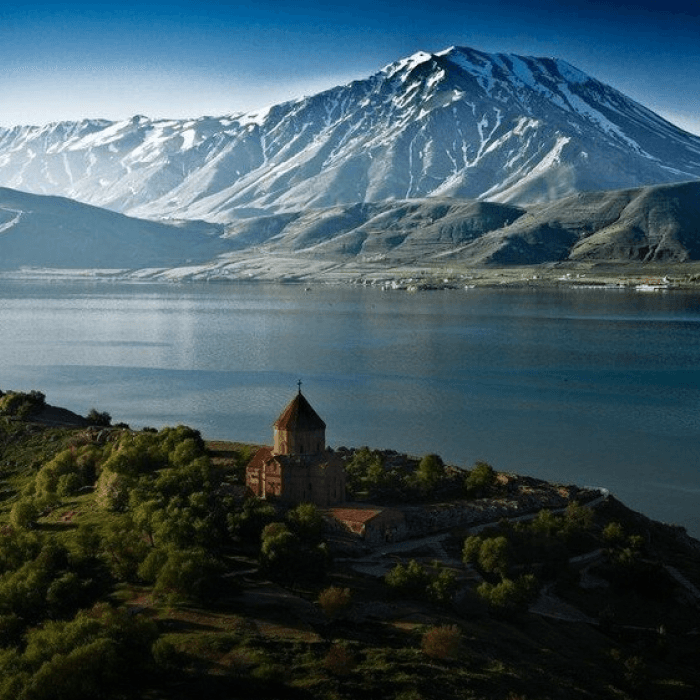
This route is especially beautiful for its contrast. In the morning we see the vast blue expanse of Lake Sevan and an ancient monastery high above it. Then we cross a mountain pass, and within a short time the landscape changes completely. The dry highlands are left behind, and dense forests, green ravines and the mountains of Tavush appear ahead. Further on lies cozy Dilijan, the ancient monasteries of Haghartsin and Goshavank, and the small forest lake of Parz. Sevan → mountains → Dilijan → forests → ancient monasteries → Lake Parz. This is one of those routes where the road itself becomes part of the journey.
At the agreed time, an Amaras Tour car arrives directly at the address you specify in Yerevan — a hotel, apartment or another pre-arranged location. No shared meeting point, no waiting for other tourists — the route belongs only to you and your company. We head north out of Yerevan, toward the Gegharkunik region.
The first major impression of the day is Lake Sevan. It sits at an altitude of about 1,900 meters above sea level and is Armenia's largest lake. Because of its enormous expanse of water, Sevan is often called the Armenian Sea. The lake's color is constantly changing, depending on weather, clouds, wind and the position of the sun: sometimes Sevan is dark blue, sometimes bright azure, and in clear weather the water takes on almost turquoise shades.
On a rise above the lake stands one of Armenia's most recognizable monasteries — Sevanavank. Today the monastery sits on a peninsula, but historically it was a genuine island, cut off from the shore by water. We climb to the monastery up a staircase, and the higher we go, the wider the panorama of Sevan becomes.
Monastic life on the island has early Christian roots. The complex's main surviving churches date to the 9th century: the churches of Surb Arakelots and Surb Astvatsatsin were built here in 874. Their construction is linked to Princess Mariam, daughter of Ashot Bagratuni, the future King Ashot I. The monastery gradually grew into an important spiritual center of the region.
Old photographs of Sevanavank look very different from today's: the monastery used to stand on a genuine island. In the 20th century a significant drop in Sevan's water level joined the island to the shore by a strip of land — and so today's peninsula was formed.
After getting to know the monastery, we leave time for a walk and photographs. From here the true scale of Sevan is well felt: in clear weather you can see the enormous surface of the lake and the surrounding mountain ranges. After Sevan we continue north, and one of the most beautiful stretches of road begins.
Gradually we leave Gegharkunik behind and head toward Tavush. Past the mountain section, the road brings us into a completely different natural world: dense forests appear, the mountains turn green, and the air becomes more humid and cool. We enter one of the greenest regions of Armenia.
Dilijan lies in the valley of the Aghstev River, amid forested mountains. The town sits at roughly 1,100–1,500 meters above sea level. Thanks to its climate, forests and mountain air, Dilijan developed as a resort destination as far back as the 19th–20th centuries. Today much of the surrounding forest belongs to Dilijan National Park — it is this nature that makes the region so different from Yerevan or southern Armenia.
Dilijan is often informally called "Armenia's Switzerland," and the reason is clear as soon as you enter the region. The landscape here is completely different: dense forests, mountain slopes, small lakes, a cool climate and green ravines. But the real Dilijan is interesting for more than its nature alone: the town has its own architecture, craft traditions and the atmosphere of an old resort town.
We stop in the historic part of town, where Dilijan's traditional 19th-century architecture has been preserved and restored. Stone houses, wooden balconies, small workshops and narrow lanes create an entirely different atmosphere — a good place for an unhurried walk, photographs and getting to know the town.
One of the most recognizable spots in Old Dilijan is Sharambeyan Street. Here you can see traditional wooden balconies and elements of the urban architecture typical of old Dilijan, along with small craft workshops and souvenir spaces. We leave time for a walk and free photography.
After Dilijan we head deeper into the forests of the national park. The road passes through mountains and dense vegetation, and in one of the green ravines the Haghartsin Monastery appears — one of the most beautiful examples of how medieval Armenian architecture can literally merge with nature.
The monastic complex took shape roughly between the 10th and 13th centuries: churches, gavits, a refectory and other monastic buildings were constructed here over different periods, with especially active development in the 12th–13th centuries. The Armenian princely house of the Bagratunis is linked to the monastery's history.
One of the complex's oldest core buildings is the Church of Surb Grigor, dating to the early period of the monastery's formation. Other buildings later appeared around it, and Haghartsin gradually grew into a major spiritual center of the region. The largest and most architecturally expressive church of the complex is Surb Astvatsatsin, built in 1281: its tall dome is clearly visible among the surrounding forests, and despite its wealth of architectural detail, the church looks light and harmonious.
The monastery's refectory deserves special attention. It was built in 1248 by the architect Minas. Its large interior space is divided by stone piers — one of the most interesting surviving examples of medieval monastic architecture of this kind in Armenia.
A popular legend is tied to the name Haghartsin: according to tradition, eagles circled above its dome during the monastery's consecration, and the name is sometimes linked to Armenian words evoking the image of "the play of eagles." It is a beautiful monastic legend that has become part of local tradition.
Behind the monastery stands the trunk of a famous old walnut tree, tied to another local tradition. It is said that if you pass through the hollow in the trunk and make a wish, it may come true. Of course, it is only a legend — but it is exactly such small stories that make a journey feel alive.
After Haghartsin we continue through the forests of Tavush toward the village of Gosh, home to one of medieval Armenia's most important centers of learning and spirituality — Goshavank. The monastic complex was founded in the late 12th century, and its history is closely tied to the outstanding Armenian thinker, scholar and jurist Mkhitar Gosh. It was originally called Nor Getik, "New Getik," and later, after Mkhitar Gosh's death, the complex took the name Goshavank, "Gosh's Monastery."
Mkhitar Gosh is one of the outstanding figures of the Armenian Middle Ages. He was a scholar, theologian, writer and jurist; his "Lawcode" is especially renowned as one of the most important monuments of medieval Armenian legal thought. Under Mkhitar Gosh the monastery became not only a religious but also a major educational center: students studied here, manuscripts were created, and medieval Armenian scholarship flourished.
Before Goshavank there stood another monastery, Getik, which was destroyed by an earthquake. Mkhitar Gosh, with the support of Prince Ivane Zakaryan, then founded a new monastic center — hence its original name, Nor Getik, "New Getik." It later became known as Goshavank.
The complex includes several churches, a gavit, chapels and buildings connected with the monastery's school and library; the main buildings date to the 12th–13th centuries. But one of Goshavank's greatest treasures is its khachkars. The monastery is famous for its intricately carved khachkars, most notably the work of the master Pogos, created in the late 13th century. The ornamentation is so fine and layered that from a distance it looks less like stone than genuine lace — one of the finest examples of medieval Armenian stone-carving craftsmanship.
After a rich historical stretch, we end the day with nature. We head to Lake Parz, tucked away among the forests of Dilijan National Park. The name "Parz" translates from Armenian as "clear" or "transparent" — a small forest lake surrounded by green hills.
After the monasteries there is no need for a long excursion here — this is a place to rest. You can walk around the lake, sit by the water, have a coffee, take photographs, and simply enjoy the quiet of the forest. Depending on the season, additional activities may be available on site; these are paid separately.
After a day full of history and architecture, the lake becomes a calm finale to the route. We began the morning at the vast, high-altitude Lake Sevan, and end the journey at a very different lake — small, quiet and hidden among the forests. Two lakes in a single day, and utterly unlike each other.
Meals are not included in the base price of the individual tour. On request, a lunch stop can be arranged — in Dilijan, near Haghartsin, or at one of the restaurants along the route. In the individual format, the restaurant and the length of the stop can be agreed in advance.
After resting at Lake Parz, we head back to Yerevan. At the end of the journey, the Amaras Tour car takes you directly to the address you specified — a hotel, apartment or another pre-arranged location. The estimated duration of the trip is 10–11 hours.
Useful information
Booking is required
You can only join the excursion with a booking made in advance. Please do not come to the meeting point without a confirmed reservation, as seats cannot be guaranteed on the day.
To book, contact Amaras Tour ahead of time with the tour you have chosen, your travel date and the number of people. Once we confirm availability we will send you everything you need to complete the booking.
- WhatsApp / Telegram: +374 99 250 525
After your booking is confirmed your seat in the group is held for you.
Meeting point and time
Meeting point: 51 Mesrop Mashtots Avenue, Yerevan, at the lower side of the Matenadaran, next to the Bus Voyage stop, where Koryun Street meets Mashtots Avenue.
Please arrive 10 to 15 minutes before departure so you have time to find the vehicle and take your seat. The excursion leaves on schedule.
Finding our vehicle
The Amaras Tour vehicle will be waiting at the meeting point. It carries an AMARAS TOUR sign in the windscreen, so it is easy to spot.
What the price includes
- Comfortable transport for the whole route
- A professional guide
- Commentary in Armenian, Russian or English
- Bottled water
- An Armenian treat from Amaras Tour
What the price does not include
- Entrance tickets
- Lunch and other meals
- Personal expenses
Entrance tickets
Entrance tickets are bought and paid for separately on site.
Meals
Lunch is not included in the price. Time is set aside for a meal during the tour, and your guide will suggest a suitable place to fit the programme and the timing.
You are welcome to bring a snack of your own.
Visiting churches and monasteries
The excursion visits working religious sites, so we ask you to dress respectfully and to follow the rules of conduct.
Clothing that covers the shoulders and knees is recommended. Please keep quiet inside the churches and bear in mind that services, weddings and other ceremonies may be taking place during your visit.
What to bring
We recommend bringing:
- comfortable shoes
- a hat in hot weather
- a light jumper or windbreaker in cooler months
- a snack if you would like one
Bottled water is provided by the company during the excursion.
Duration and programme
The approximate duration of the excursion is given in the tour description. The actual time of return may shift slightly depending on traffic, the weather and how long the group spends at each site.
The order in which the sights are visited may change for practical reasons, but the main points of the published route are always kept.
Route
- 1Lake Sevan
- 2Sevanavank Monastery
- 3Dilijan
- 4Old Dilijan
- 5Haghartsin Monastery
- 6Goshavank Monastery
- 7Lake Parz