
Private Tour: From Bjni Fortress to the Peaks of Tsaghkadzor and Lake Sevan
We built this route so that over the course of one day the scenery and impressions keep changing. First — an old Armenian village and a fortress high above a gorge. Then — the medieval Kecharis Monastery and the story of one of Armenia's most important princely families. After that — mountainous Tsaghkadzor and a ride up the cable car to the slopes of Mount Tegenis. And the finale of the journey is the vast blue expanse of Lake Sevan and the ancient Sevanavank. Bjni → Tsaghkadzor → the mountains → Sevan — this is the route where, in a single day, you can see several completely different faces of Armenia.
At 09:00 the Amaras Tour car arrives directly at the address you specify in Yerevan — your hotel, apartment, or another agreed meeting point. There are no shared pick-up points and no waiting for other participants: this day belongs only to you and your company. After you board, we head to the Kotayk region. The first stop will be Bjni.
Bjni is an old Armenian village in the gorge of the Hrazdan River. Today its name is mostly associated with the famous Armenian mineral water, but the history of the place is far older: in the Middle Ages Bjni had strategic importance and was tied to the powerful princely house of Pahlavuni. Above the village the ruins of an ancient fortress still rise.
The fortress stands on a high rocky outcrop — the site was chosen for good reason: from up here it was possible to control the gorge and the roads running through this part of Armenia. The fortress was one of the key strongholds of the Pahlavuni family and was especially active in the Middle Ages. Its fortifications date to the 9th–10th centuries, when this territory was under the influence of the Bagratuni dynasty and the Pahlavuni princely house, and the fortress gained particular importance in the 11th century. One of the family's best-known members was Grigor Magistros Pahlavuni — a prince, statesman, scholar and one of the notable intellectuals of medieval Armenia. We will meet his name again today — in Tsaghkadzor.
The fortress has not survived intact to our day: we will see the remains of defensive walls, fortifications and traces of structures that once stood inside. But the main value of this place is the chance to feel the very geography of a medieval fortress. Standing at the top, it is easy to understand why this particular rock was chosen for defense — from here open beautiful views of Bjni, the gorge and the surrounding mountains. Comfortable shoes are essential for visiting the fortress, since part of the route is on foot over natural terrain.
After the fortress we get to know another important monument of Bjni — the Church of Surb Astvatsatsin, the Holy Mother of God. It was built in 1031, and its construction is linked to the same Grigor Magistros Pahlavuni. In this way Bjni becomes a fine historical introduction to the next part of the journey — because it was the Pahlavuni family that also played a crucial role in the history of Kecharis Monastery.
From Bjni we continue toward Tsaghkadzor. The road gradually climbs higher, the vegetation changes, forested mountain slopes appear, and the air grows cooler. Soon we arrive at one of Armenia's best-known mountain resorts.
The name Tsaghkadzor can be literally translated as "valley of flowers". The town lies at about 1,840 metres above sea level, on the slopes of Mount Tegenis, and today is known as Armenia's main ski and year-round mountain resort: in winter people come here for the snow and skiing, in summer — for the mountains, cool air, walks and panoramas. But the history of Tsaghkadzor began long before the modern hotels and the cable car.
In the historic part of Tsaghkadzor stands the Kecharis monastery complex — one of the most important medieval monastic ensembles of Kotayk. The main complex took shape in the 11th–13th centuries, and the history of Kecharis is closely tied to the Pahlavuni princely house.
One of the key figures in the monastery's history was, again, Grigor Magistros Pahlavuni, whom we already met in Bjni — not just a member of an influential princely family, but an educated statesman, philosopher and scholar of his time. It was under the Pahlavuni that the active development of Kecharis began. So two points of our route — Bjni and Kecharis — are joined by one story, which makes the journey far more interesting than a simple list of sights.
In the 12th–13th centuries Kecharis grew into a major spiritual and cultural centre of medieval Armenia. The monastery had a school, and spiritual figures, scholars and manuscript masters lived and worked here. The complex developed over several centuries, so today you can see structures from different periods.
The complex includes several churches, a chapel, a gavit and khachkars. One of its main churches is Surb Grigor Lusavorich; later the ensemble was expanded with new structures, some of them dating to the 13th century. That is why Kecharis is interesting not as a single church, but as a genuine medieval monastery complex.
After the history — it's time to rise higher into the mountains. We head to the famous Tsaghkadzor cable car: the ascent runs along the slopes of Mount Tegenis. As we go up, the town sinks lower and lower, the forest gradually gives way to open mountain spaces, and the panorama grows ever wider.
Tsaghkadzor lies on the eastern slope of Mount Tegenis. The cable car has several sections and carries guests high above the resort. In good weather it offers wide panoramas of Kotayk and the surrounding mountains: in winter we see snowy slopes, in spring and summer — green alpine landscapes, in autumn — an entirely different palette of colours. That is why this route is beautiful in almost any season.
Since this is a private tour, there is no need to rush here: you can ride the cable car, take photos, have a coffee, take a short walk, and simply enjoy the mountain air. We adjust the length of the stop to your wishes. Cable car tickets are paid separately, and its operation depends on the season and weather conditions.
After Tsaghkadzor the scenery changes again — now we head into the Gegharkunik region. The road gradually brings us to a huge blue expanse: Lake Sevan comes into view.
Sevan is Armenia's largest lake and one of the country's main natural symbols. It lies at about 1,900 metres above sea level, which is why the climate here differs from Yerevan: even in summer it can be cool and windy by the water. Sevan is often called the Armenian Sea — when you stand on the shore and look at the water stretching to the horizon, it becomes clear why.
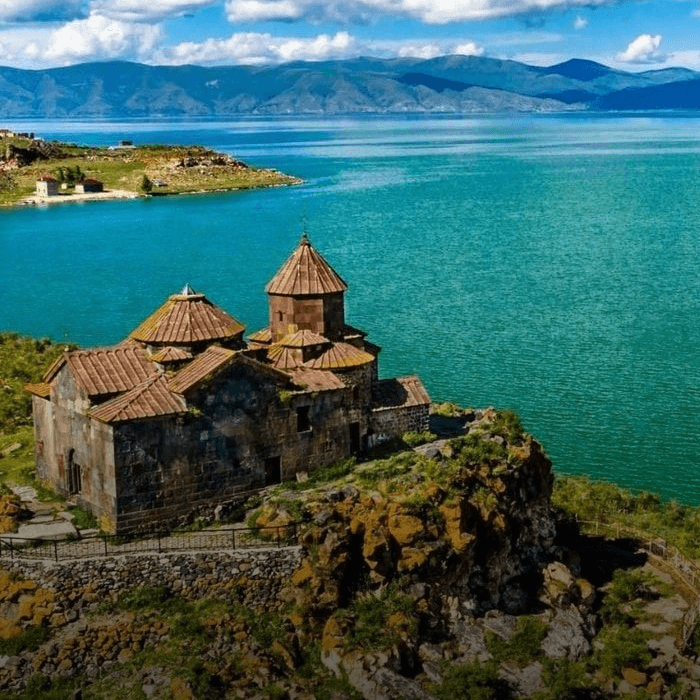
On a peninsula above the lake stands the famous Sevanavank Monastery. Reaching the monastery means climbing a staircase, but at the top opens one of Armenia's most recognisable views: on one side — ancient stone churches, on the other — the vast expanse of Sevan and the mountains around it.
The monastic tradition of this place has early roots, but the main surviving churches of the complex date to the 9th century. In 874 the churches of Surb Arakelots and Surb Astvatsatsin were built here, and their construction is linked to Princess Mariam, daughter of Ashot I Bagratuni, the future king of Armenia.
Today Sevanavank can be reached by land, but historically the monastery stood on an island. In the 20th century the water level of Sevan dropped significantly, and the former island became a peninsula — which is why old photographs of Sevanavank look entirely different, showing the monastery rising literally out of the water.
After learning about the monastery's history, we leave time for a walk: there is no rush to return to the car — instead we quietly take photos, look at Sevan from above, and simply rest after a full day. On request, lunch can be arranged near Sevan — Armenian cuisine or dishes made from local fish; meals are not included in the base price of the private tour and are paid separately, and the restaurant and length of the stop can be agreed in advance.
After Sevan we begin the drive back. At the end of the journey the Amaras Tour car takes you directly to the address you specify in Yerevan. The approximate duration of the whole trip is 9–10 hours.
Useful information
Booking is required
You can only join the excursion with a booking made in advance. Please do not come to the meeting point without a confirmed reservation, as seats cannot be guaranteed on the day.
To book, contact Amaras Tour ahead of time with the tour you have chosen, your travel date and the number of people. Once we confirm availability we will send you everything you need to complete the booking.
- WhatsApp / Telegram: +374 99 250 525
After your booking is confirmed your seat in the group is held for you.
Meeting point and time
Meeting point: 51 Mesrop Mashtots Avenue, Yerevan, at the lower side of the Matenadaran, next to the Bus Voyage stop, where Koryun Street meets Mashtots Avenue.
Please arrive 10 to 15 minutes before departure so you have time to find the vehicle and take your seat. The excursion leaves on schedule.
Finding our vehicle
The Amaras Tour vehicle will be waiting at the meeting point. It carries an AMARAS TOUR sign in the windscreen, so it is easy to spot.
What the price includes
- Comfortable transport for the whole route
- A professional guide
- Commentary in Armenian, Russian or English
- Bottled water
- An Armenian treat from Amaras Tour
What the price does not include
- Entrance tickets
- Lunch and other meals
- Personal expenses
Entrance tickets
Entrance tickets are bought and paid for separately on site.
Meals
Lunch is not included in the price. Time is set aside for a meal during the tour, and your guide will suggest a suitable place to fit the programme and the timing.
You are welcome to bring a snack of your own.
Visiting churches and monasteries
The excursion visits working religious sites, so we ask you to dress respectfully and to follow the rules of conduct.
Clothing that covers the shoulders and knees is recommended. Please keep quiet inside the churches and bear in mind that services, weddings and other ceremonies may be taking place during your visit.
What to bring
We recommend bringing:
- comfortable shoes
- a hat in hot weather
- a light jumper or windbreaker in cooler months
- a snack if you would like one
Bottled water is provided by the company during the excursion.
Duration and programme
The approximate duration of the excursion is given in the tour description. The actual time of return may shift slightly depending on traffic, the weather and how long the group spends at each site.
The order in which the sights are visited may change for practical reasons, but the main points of the published route are always kept.
Route
- 1Bjni
- 2Bjni Fortress
- 3Surb Astvatsatsin Church
- 4Tsaghkadzor
- 5Kecharis Monastery
- 6Cable Car
- 7Mount Tegenis
- 8Lake Sevan
- 9Sevanavank